
Set up commission plans
Write what the brokerage takes from each agent, from a simple 70/30 split to a capped plan, and the plans most brokerages use.
- Who this is for:
- transaction coordinators, real estate agents
- Updated
- Nov 9, 2026
- 4 min read
A commission plan says what the brokerage takes from each agent's commission. Set it up once per kind of agent. After that, every deal works out the agent's pay by itself.
How a plan works
- A plan is a short list of rules, read top to bottom. Each rule is one sentence.
- Each rule takes something for the brokerage: a percent, a percent until a yearly amount is reached, or a flat amount.
- The agent keeps everything that is left.
- Each agent is on one plan at a time. Many agents can share a plan.
Plans are in Settings › Agent Commission Plans. Only an account manager can change them.
Create a plan
- Press New plan, name it, and press Create.Use a name agents will recognize, like "80/20, $18,000 cap".
- Choose when Yearly amounts start over.January 1 for everyone, or a date for each agent (their start date, for example). This only matters for caps.
- Press Add a rule and pick what kind of rule.Fill in the percent or amount, then press Add this rule. Add more rules the same way.
- Check Try it on a deal.Type a commission and see what the brokerage takes and what the agent keeps.
- Tick the agents under Who is on this plan and press Save who is on this plan.Offerin uses it to work out their pay on each deal.
The three kinds of rule
- A percentage, with no limit. Takes the same percent of every deal. "The brokerage takes 30%."
- A percentage, up to a yearly amount. Takes a percent until it has collected the yearly amount (the cap), then stops until the year starts over.
- A flat amount. Takes the same dollars on every deal. "The brokerage takes $395."
Two settings change how a rule runs:
- What it applies to: the whole commission, or only what is left after the rules above it.
- When it runs: on every deal, or only after the yearly amounts above it have been collected. Use the second one for a fee that starts once an agent caps.
Plans most brokerages use
Straight split (70/30, 80/20, 50/50)
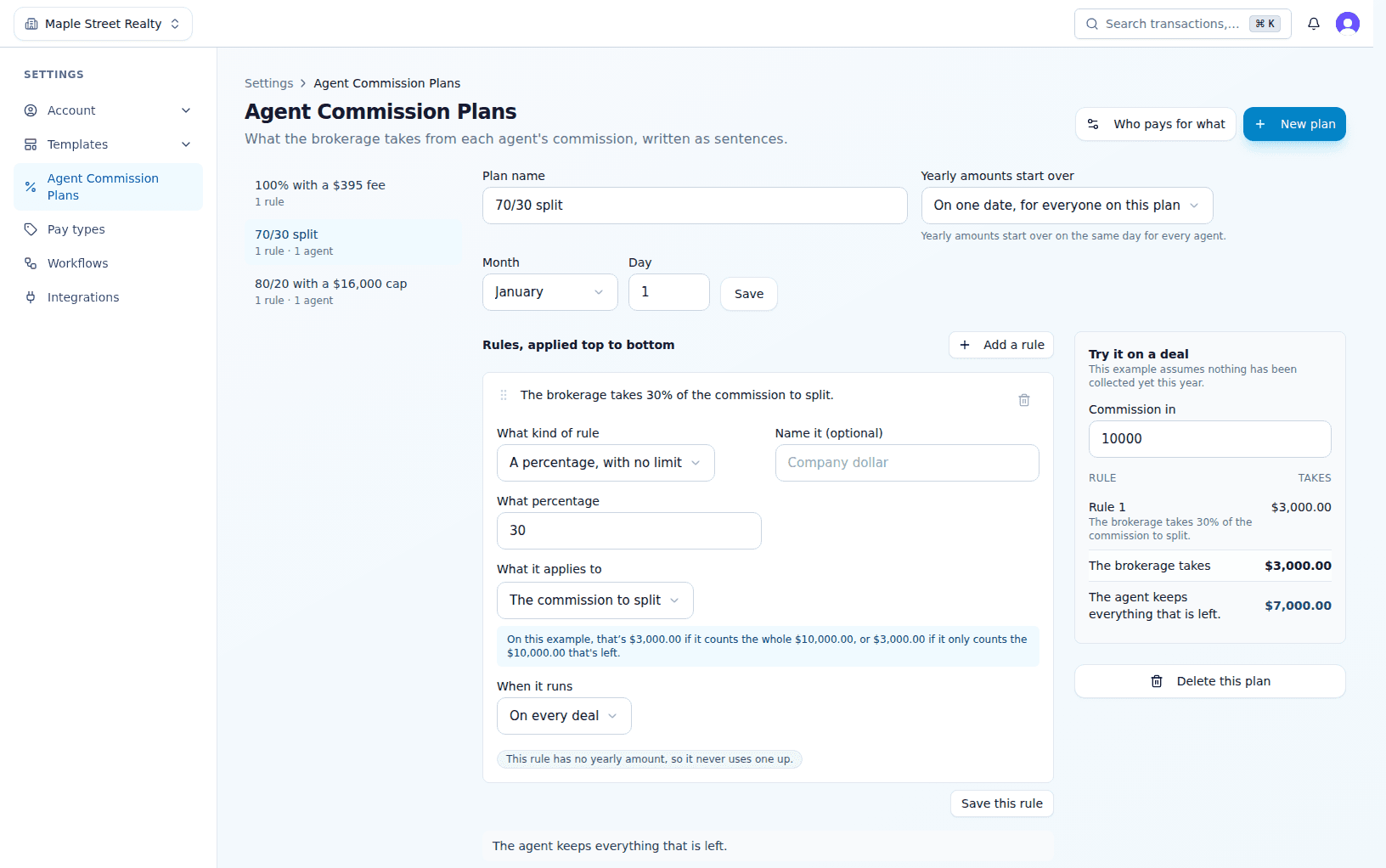
The brokerage takes the same percent of every deal, all year. Common for newer agents (50/50 or 60/40) and as a simple default (70/30). One rule: a percentage, with no limit.
Capped split
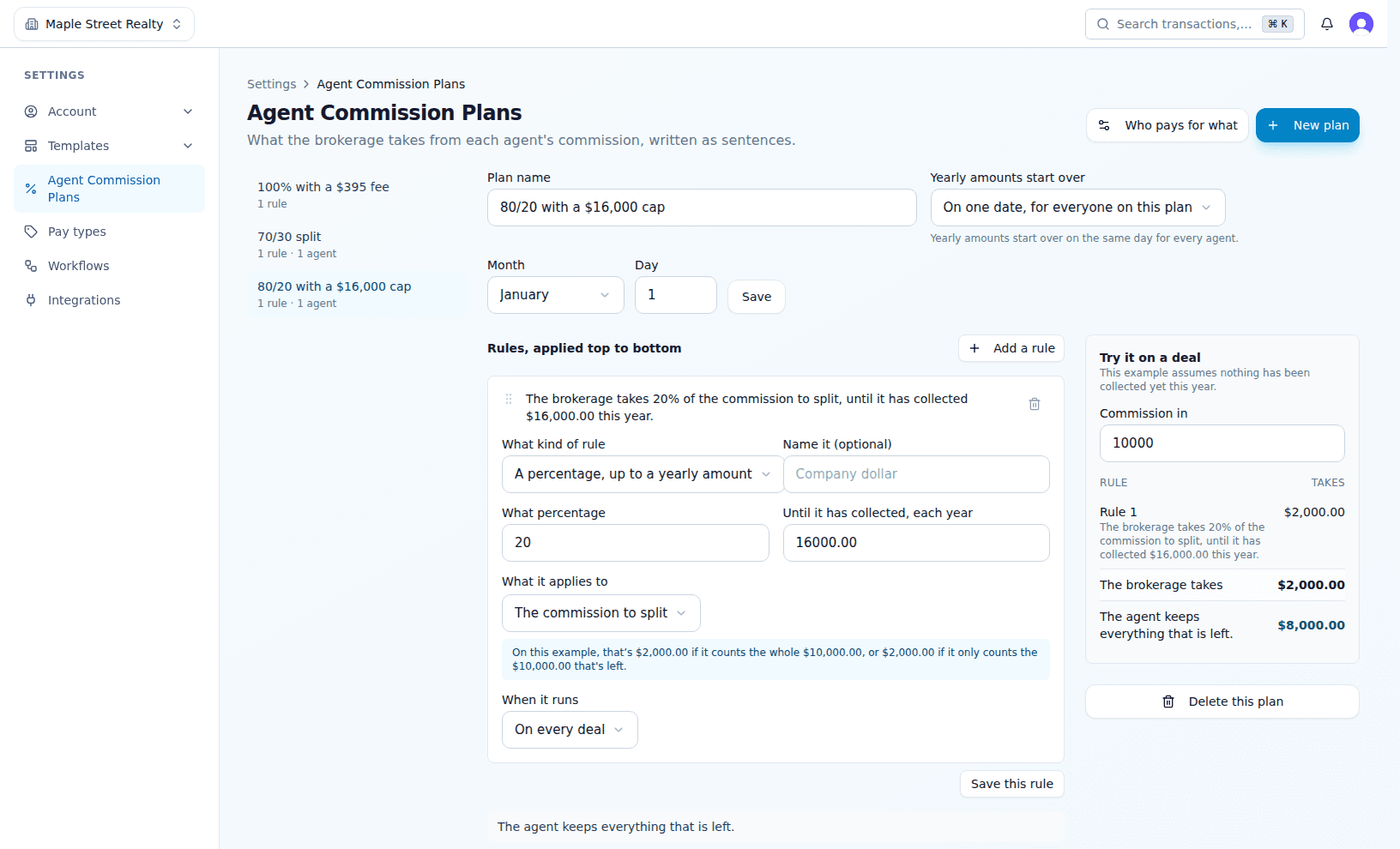
The brokerage takes a percent until it has collected a yearly amount, then the agent keeps 100% until the year starts over. Popular with experienced agents. One rule: a percentage, up to a yearly amount.
Capped split with a fee after the cap
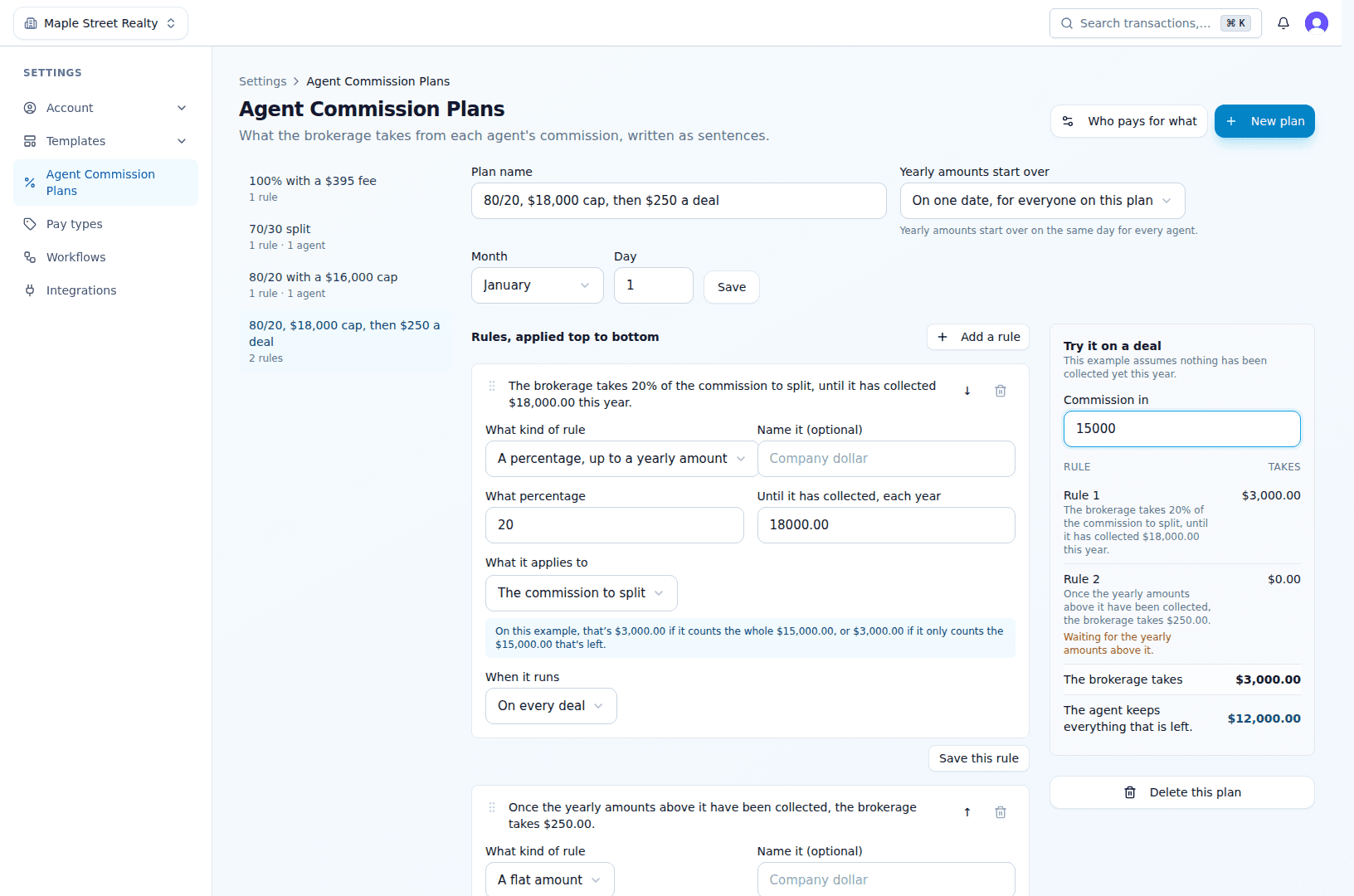
Same as above, but once the agent caps the brokerage still takes a small flat fee on each deal to cover its costs. Two rules: the capped percentage, then a flat amount that runs only after the yearly amounts above it.
100% plan with a flat fee
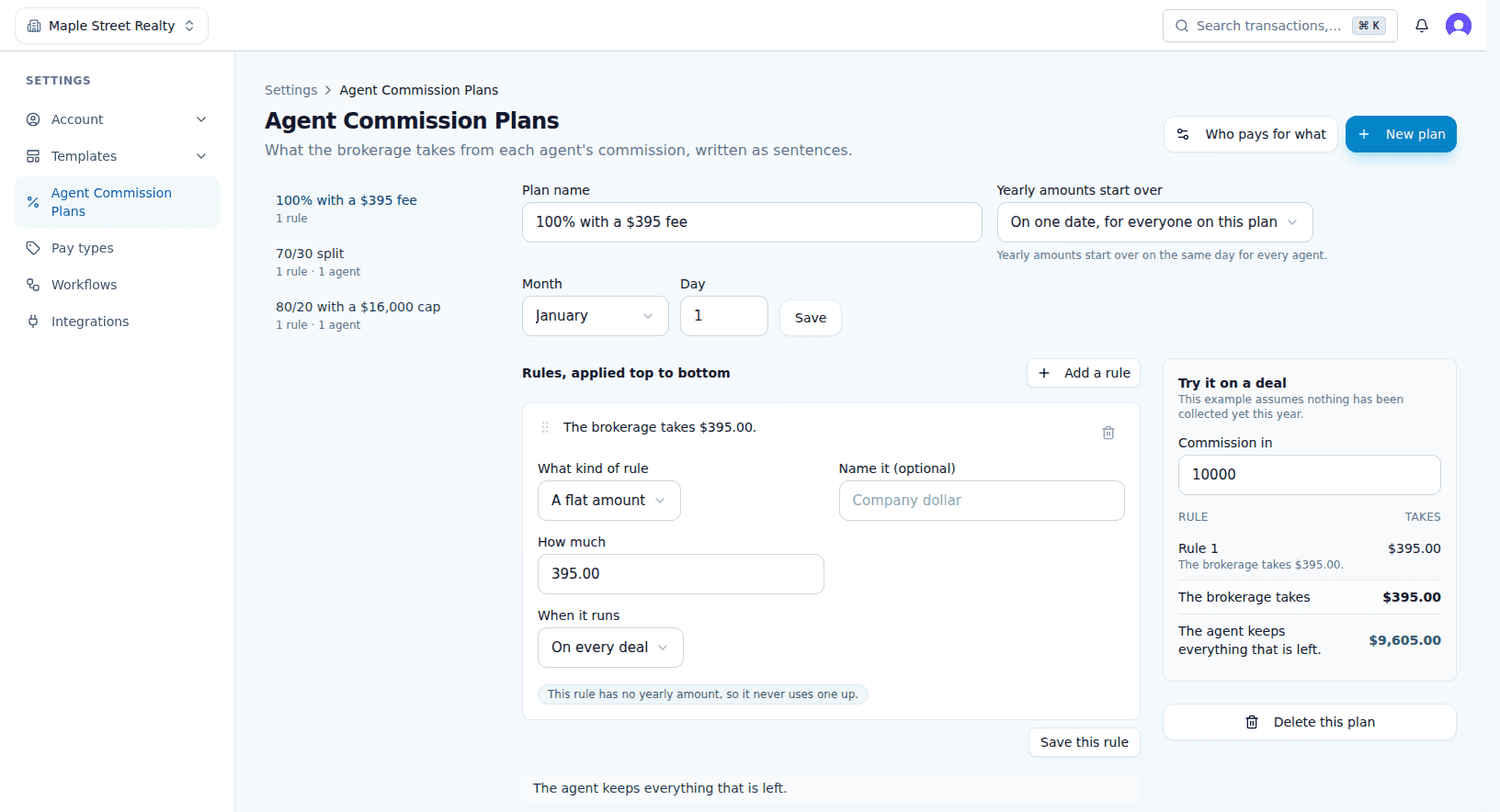
The agent keeps the whole commission and the brokerage takes a set amount per deal. Common for top producers and low-fee brokerages. One rule: a flat amount.
Graduated split
The agent's share grows as they earn more in the year, for example 60/40 until the brokerage has collected $20,000, then 75/25. Two rules: 40% up to a yearly amount of $20,000, then 25% with no limit that runs only after the yearly amounts above it.
Franchise or company fee on top
Many brokerages take a fee off every deal before the split, such as a 6% franchise fee. Put it first as a percentage with no limit, name it ("Franchise fee"), and set the split rule under it to apply to what is left.
Related articles
Give each of your agents a percent of the deal. Each share then goes through that agent's own plan.
Record an agent's commission payment from the Money page or the deal, with one date and one reference.
One page for what came in, what needs approving and who to pay, and how to fix a payment.